
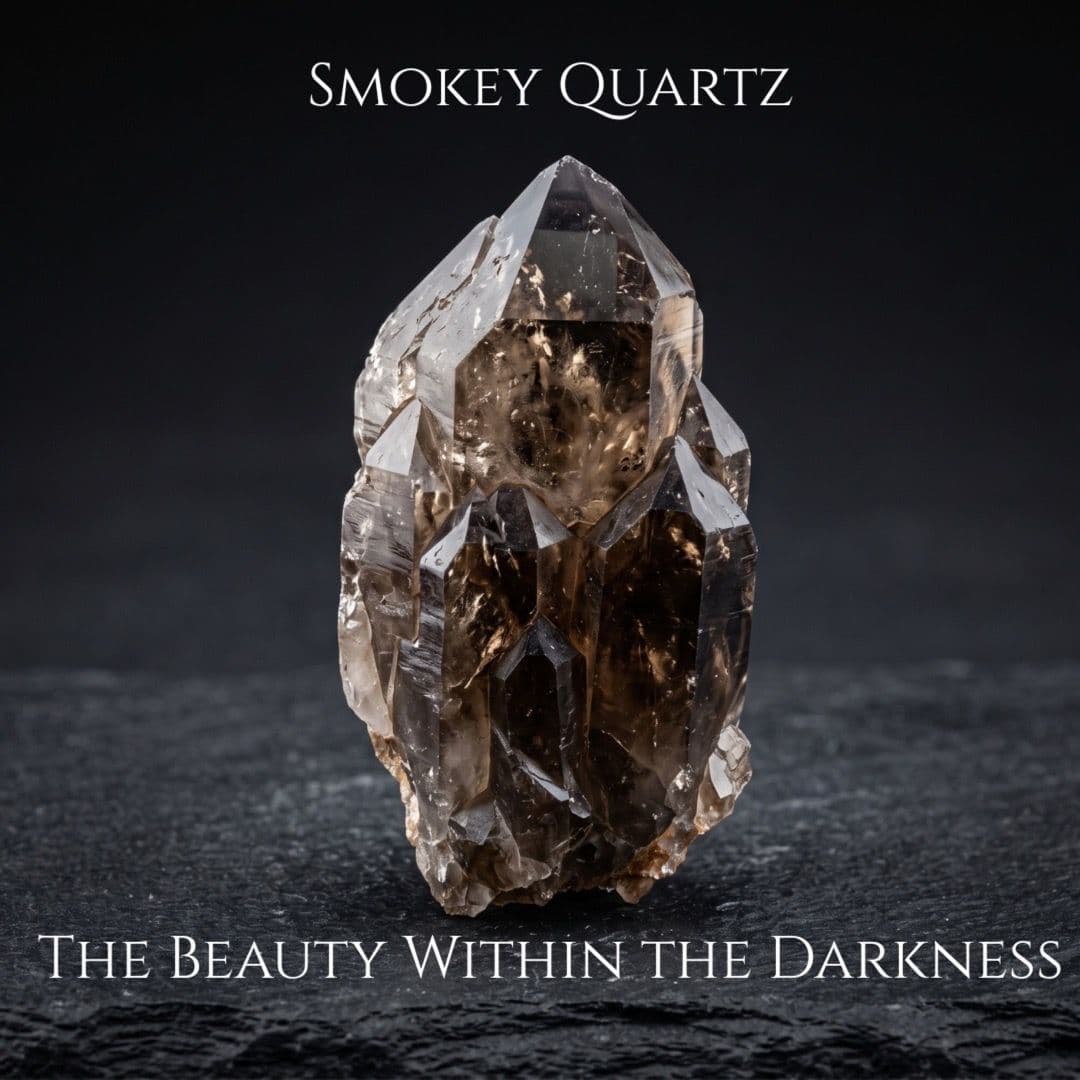
There is something particularly captivating about Smokey Quartz. Unlike the bright purple of Amethyst or the delicate pink of Rose Quartz, Smokey Quartz has a quieter beauty. Its colours range from pale smoky grey and warm brown through to deep chocolate, almost black, with some crystals appearing remarkably dark until light passes through them. It is a variety of Quartz, but it is far from being simply another form of the mineral. The colour of Smokey Quartz has a fascinating connection with natural radiation, the chemistry of the crystal and the conditions in which it formed.
For me, this is part of what makes Smokey Quartz such an interesting mineral to collect. It can be beautiful as a crystal, fascinating from a geological perspective and, within the world of crystal traditions, has developed a distinctive character of its own.
What is Smokey Quartz?
Smokey Quartz is a variety of Quartz with the chemical formula SiO₂. Its characteristic grey, brown or almost black colour is associated with radiation-induced colour centres within the crystal structure, involving trace amounts of aluminium replacing some of the silicon in the Quartz lattice.
Natural radiation occurring within the Earth's crust can interact with these impurities over geological periods of time, producing the smoky colour we see today. The exact chemistry and colour mechanism is more complex than the simple description of "irradiated Quartz", but natural irradiation is an important part of the story of Smokey Quartz.
This also helps explain why Smokey Quartz can display such a remarkable range of colours.
Some specimens are almost colourless with just a hint of smoke. Others have a beautiful tea-brown colour, while the darkest examples can appear almost black. The German name Morion is sometimes used for very dark or black Smokey Quartz.
How does Smokey Quartz get its colour?
One of the most fascinating things about Smokey Quartz is that its colour isn't simply caused by another mineral being mixed into the Quartz.
During crystal growth, small amounts of aluminium can substitute for silicon within the Quartz structure. Natural radiation can then alter the electronic state of these impurities, producing what are known as colour centres.
It sounds complicated — and at an atomic level, it is — but the result is wonderfully simple to see.
The Quartz becomes smoky.
This is one reason mineral collectors can find Smokey Quartz so fascinating. What looks like a relatively simple brown or grey crystal is actually recording part of the geological history of the environment in which it formed.
Research into Quartz colour has also demonstrated that Smokey Quartz can be produced artificially through irradiation. This is an important distinction when buying specimens because naturally coloured Smokey Quartz and artificially irradiated Quartz are not necessarily the same thing.
From pale grey to almost black
One of the great pleasures of collecting Smokey Quartz is its variety.
There isn't just one Smokey Quartz colour.
You can find:
- pale smoky grey
- silvery grey
- golden-brown
- honey-brown
- warm cinnamon-brown
- deep chocolate brown
- very dark brown
- almost black
The transparency can vary just as much.
Some crystals allow light to pass beautifully through their interiors, revealing subtle layers of colour and internal features. Others are much darker and more opaque-looking.
A particularly dark specimen can look almost black from one direction, yet reveal its brown or smoky character when held against a strong light source.
This is one of those minerals that photographs don't always capture particularly well. A crystal can look very different in natural daylight compared with artificial lighting, and the depth of colour can be difficult to appreciate until you hold the specimen yourself.
Smokey Quartz as a mineral specimen
Although Smokey Quartz is widely known within the crystal world, it is also an important mineral for collectors.
Well-formed crystals can develop attractive terminations, interesting growth patterns and inclusions. Some occur as individual crystals, while others form groups or occur alongside other minerals.
Quartz is particularly good at hosting inclusions, and Smokey Quartz is no exception. In some specimens, other minerals can be enclosed within the Quartz, creating fascinating miniature geological landscapes.
The Gemological Institute of America has documented Smokey Quartz specimens containing minerals such as spessartine garnet. One example from the Little Three mine near Ramona, California, contained a small garnet crystal enclosed within a smoky brown Quartz crystal.
This is where Smokey Quartz moves beyond being simply a "crystal" and becomes something rather more interesting: a mineral specimen that can preserve a record of the conditions under which it formed.
Where is Smokey Quartz found?
Smokey Quartz occurs in a number of locations around the world.
Some of the best-known material has come from places including Scotland, Switzerland, the United States and Brazil, although Smokey Quartz is found in many other regions as well.
The famous Cairngorm Mountains of Scotland have given their name to Cairngorm, a term historically associated with Scottish brown Smokey Quartz. Scottish Smokey Quartz has a particularly interesting place in mineral history and has been used for jewellery and ornamental objects for centuries.
The Alps are another historically important source, while parts of the United States have produced exceptional collector specimens.
Smokey Quartz can also occur in granitic pegmatites, where it may be found alongside minerals such as feldspar and mica. Pegmatites are particularly important environments for mineral collectors because they can produce exceptionally large and well-formed crystals.
Smokey Quartz in crystal traditions
Alongside its geological story, Smokey Quartz has developed a strong identity within the world of crystals.
Traditionally, Smokey Quartz is associated with grounding, stability and connection with the physical world.
It is often chosen by people who feel drawn towards a quieter, more settled energy and is traditionally regarded as a stone for helping one remain centred when life feels busy or overwhelming.
These are traditional crystal associations rather than scientifically established effects. There is no scientific evidence that Smokey Quartz can treat illness or produce specific physical or psychological effects.
That distinction is important.
Crystals can have meaning without needing to be presented as medicine.
For many people, the value of a crystal lies in the relationship they develop with it — the symbolism it carries, the reminder it provides or simply the pleasure of holding and living with something beautiful from the natural world.
Why is Smokey Quartz associated with grounding?
The grounding association is perhaps one of the most persistent traditions surrounding Smokey Quartz.
It isn't difficult to understand why.
Its earthy colours — grey, brown, charcoal and deep chocolate — naturally evoke stone, soil, woodland and the landscape around us.
Compared with the brighter colours of many other Quartz varieties, Smokey Quartz has a restrained appearance.
It doesn't demand attention.
Instead, it has a quiet presence.
Within crystal traditions, this has led to associations with steadiness, grounding and maintaining a connection with everyday life.
For some people, that symbolism is exactly what makes Smokey Quartz appealing.
Smokey Quartz and meditation
Smokey Quartz is also commonly used in meditation and other reflective practices.
Some people simply hold a piece while sitting quietly. Others keep a specimen nearby as a physical reminder to slow down and become more present.
There is no particular way that a crystal has to be used.
A beautiful mineral specimen sitting on a desk can be just as meaningful as a polished stone carried in a pocket.
Sometimes the most valuable thing a crystal does is simply give us a reason to pause.
Choosing a piece of Smokey Quartz
If you're looking for Smokey Quartz, I think it is worth taking your time.
There is enormous variation between individual pieces, even when they have come from the same general locality.
Look at the colour first.
Do you prefer a delicate smoky grey, a warm brown or something much darker?
Then look at the crystal itself.
Is it a single terminated crystal? A cluster? A specimen with interesting inclusions? Does it have an unusual shape or growth pattern?
Transparency is another consideration.
A relatively clear Smokey Quartz can allow you to see deep into the crystal, while darker material can have a completely different character.
There is no single definition of the "best" Smokey Quartz.
A collector may be fascinated by an unusual inclusion or crystal formation, while someone buying their first piece may simply fall in love with the colour.
That is one of the things I enjoy about crystals.
The piece that catches your eye isn't necessarily the piece that someone else would choose.
Natural Smokey Quartz or treated material?
This is an area worth understanding when buying Smokey Quartz.
Quartz can be artificially irradiated to create smoky colouring, and irradiated Quartz has been used commercially as mineral specimens and in the gem trade.
That doesn't automatically make treated material undesirable. Treatments are common throughout the gemstone industry.
However, transparency about treatment matters.
If you're buying a specimen because you specifically want naturally coloured Smokey Quartz, it is sensible to ask about its origin and whether the colour is natural.
For collectors, provenance and locality can also add considerably to the interest of a specimen.
Looking after Smokey Quartz
Smokey Quartz is reasonably durable because Quartz has a Mohs hardness of 7.
However, that doesn't mean it is impossible to damage.
Crystal points and terminations can chip if a specimen is knocked against another mineral or dropped onto a hard surface. As with any mineral specimen, it is worth handling larger or particularly delicate pieces carefully.
There is another interesting consideration with strongly coloured Smokey Quartz: its colour can be affected by heat and, under some circumstances, prolonged exposure to ultraviolet light. The precise behaviour varies with the material, but this is another reason to avoid exposing valuable specimens to unnecessary heat.
For most pieces, ordinary care is all that is required.
A soft cloth and gentle handling are usually preferable to aggressive cleaning methods.
Why I have always liked Smokey Quartz
There are many spectacular crystals in the mineral world.
Some catch your attention because of their colour. Others because of their size, rarity or extraordinary formations.
Smokey Quartz has always struck me as slightly different.
Its beauty is more understated.
A good piece can sit quietly on a shelf and gradually reveal more of itself as the light changes. You begin to notice the depth of the colour, the internal structure, the growth patterns and the tiny details that weren't immediately obvious.
And then there is the story behind the colour.
Radiation.
Aluminium within the crystal structure.
Millions of years of geological processes.
A piece of Smokey Quartz is therefore much more than a brown Quartz crystal. It is a small piece of geological history.
Perhaps that is why it has remained such a popular mineral with both crystal enthusiasts and serious mineral collectors.
Exploring Smokey Quartz
I currently have a good selection of Smokey Quartz available at KSC Crystals, with individual pieces offering different colours, shapes, formations and characters.
If you are drawn to Smokey Quartz, take a look through the collection and see which piece speaks to you.
You may find yourself attracted to a beautifully clear crystal, a deep dark specimen, an unusual formation or simply a piece whose colour you can't stop looking at.
There is no right choice.
The beauty of collecting crystals is that every specimen is different.
And Smokey Quartz, with its quiet colours and fascinating geological story, is a wonderful reminder that sometimes the most understated crystals can be the ones that hold our attention the longest.
Explore the Smokey Quartz Collection
If you have enjoyed discovering more about Smokey Quartz, you may like to take a look at the Smokey Quartz I currently have available at KSC Crystals. Each piece has its own colour, character and natural formation, so take your time and see which one catches your eye.
Explore the Smokey Quartz Collection :- Smokey Quartz